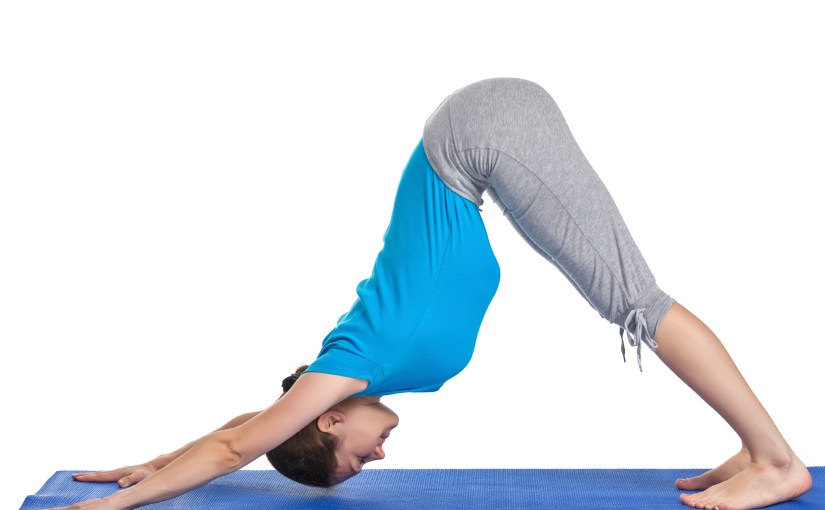
Downward-facing dog

Downward-facing dog, down dog, downward dog, adho muka svanasana – whatever you know it as –  is an integral pose of yoga.    Aligning yourself properly in this pose will reduce unnecessary strain, fatigue, and injury.  Also, understanding the benefits of down dog helps us understand why we are doing it in the first place!

First, here are some tips to help make sure you are in the pose correctly:

  • Start from plank pose with hands shoulder-distance apart making sure that your elbows are stacked directly over your wrists and your shoulders directly over your elbows.  Spread your fingers wide like you are digging in sand.  Press them into the ground paying particular attention to the forefinger and thumb.  Feet should be hip-distance apart.
  • From here lift your hips up as you move into the downward-dog position.  Try not to adjust your hands or your feet positions when you do this.  Continue to push your hands down into the ground.  Reach your heels down to the ground.  They do not actually have to touch the ground; the reaching is the important part.  If your heels do touch the ground then great!
  • Draw energy up through your arms, relax your shoulder blades towards each other, and reach your sits bones up and back.  Lift your navel in towards your back.  Let your head hang heavy and breathe.

Second, here are some benefits from down dog:

  • Helps build bone density because it is a weight baring exercise.
  • Helps wake you up and reduce fatigue.  Try the pose for at least one minute after a long day at the office.
  • It’s good for relieving upper back pain, neck pain, and for easing tension in this area.  It is also good for stress relief as the spine gets lengthened and decompressed.
  • It’s good for increasing blood circulation as the heart gets elevated above the head.  Active blood circulation aids in flushing toxins from our system, and regulating blood pressure.
  • Finally it’s good for enhancing digestion as the spleen, kidneys, and liver get compressed.  Also a good core strengthener.

There you have it.  Some tips on getting into Downward dog properly and what this pose does for our bodies as we practice it.

To your health.

Disclaimer:  All articles written on Microyogi are opinions and not meant to serve as any kind of instruction for how to move your body.  I am merely writing to serve as a means of trying to find my own answers.  I am not a certified trainer or medical expert.

yin yoga versus restorative yoga

The new yoga studio I’ve recently signed up with (Claremont Yoga – I love it!) offers an array of classes for its students.  One of which is “Yin Yoga”.    And then they offer a “Restorative Yoga” class.  Are these similar?   I’ve decided to read about them – in addition to attending the classes.  Understanding the purpose of the class and what to expect is very important and can change the outcome of the class greatly so here we go.

Yin versus yang yoga

To understand what yin yoga is we need to understand the term yang yoga.    It is probably the type of yoga you’ve been doing.  Vinyasa flow, Ashtanga, and Strala’s Strong yoga are examples of yang yoga. These are rather vigorous forms of yoga which focus on our muscles resulting in sweat and an increased heart-rate.  These forms of yoga are heat building.  As we flow through an hour of one of these classes the purpose is to build strength, stamina, and also flexibility in our muscles.

Yin is the opposite or balancing partner of yang yoga.  The roots of yin yoga are in China rather than in India as most yang yoga is. It is based on simple poses which are held for anywhere between 5 and 20 minutes.  It is meant to balance out the yang practice. Instead of focusing on the muscles, the focus in on connective tissue – the bones, the ligaments, and the joints.  The atmosphere of these classes is more meditative and the object is to relax into the poses.  Although it is described as simple it is not meant to be “easy”.   It is meant to be for those yoga practitioners who are not currently injured and to improve their health. For these yogis it will act as a restorative form of yoga.

Restorative yoga

Generally, a class which is titled “Restorative yoga” will be a very gentle form of yoga.  More low-key than yin if you will.  If you have injuries, are new to yoga, are stressed, or just want a relaxing and easy-on-the-body class then look for a restorative yoga class.  These classes often use a lot of props, encourage ease and gentleness, and do not stress the connective tissue compared with a yin class.

I tried a yin yoga class the other day.  It is more strenuous than a restorative yoga class.  The poses are held for longer than might seem comfortable.  I will say it was a different experience.  I will probably try it again.  My ultimate favorite yoga is still restorative though.  I love it for its stress reducing qualities in my life.  My body is generally very flexible and the yin will be a good addition to my practice though.  Learning to use the poses as a meditative tool will be my challenge.  Learning to relax in the poses for up to 5 minutes will also be another challenge.  But after all yoga is a practice rather than an art. So adding a new dimension to my practice is exciting.

To your health.