The power of Om (AUM)

The first yoga class that I ever attended was in Bermuda about 10 years ago.  I loved it right away but I was a little weirded-out by the whole Om (AUM) chant at the beginning and end of the class.  It seemed too “out there” and “religious” to me.  Also, being a Christian, I was wondering how inappropriate to my beliefs it was.  But it just seemed what you did and it didn’t last long so I just blundered through it. Since then I’ve been to several different yoga classes which either did or did not do this chanting.  Honestly, I did not notice if the Om (AUM) chant was missed because I felt uncomfortable about it.  If it was done in the class, I would be glad when it was over!  Maybe if I understood it better, I could appreciate it a whole lot more.  Here’s what I found out.

What is Om (AUM)?

According to Yahoo! Dictionary it is:

The supreme and most sacred syllable, consisting in Sanskrit of the three sounds (a), (u), and (m), representing various fundamental triads and believed to be the spoken essence of the universe. It is uttered as a mantra and in affirmations and blessings.

Om (AUM) comes from Hinduism and is considered the greatest of all mantras.  It represents several important triads:

  • the three worlds – earth, atmosphere, and heaven
  • the three major Hindu gods – Brahma, Vishnu, and Siva
  • the three sacred Vedic scriptures – Rg, Yajur, and Sama

Om (AUM) embodies the essence of the entire universe.  Indian philosophical belief is that God first created sound and the universe arose from this sound. As the most sacred sound, Om (AUM) is the root of the universe and everything that exists and it continues to hold everything together.

When Om (AUM) is chanted in yoga classes, the theory is that everyone present is tuning their own vibrations to resonate with the sacred vibration of the Universe. The idea is to remind ourselves we are not  alone or separate, but that we absolutely belong and are an essential note in the symphony of our universe.  Awesome!

The Om (AUM) symbol ॐ is typically displayed by yogis and serves as a means for us to recognize each other (if we couldn’t already tell by the yoga mat and flip-flops!).

I found a lovely explanation of the Om (AUM) symbol at heavenmeetsearthyoga.com:
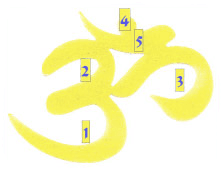
Om (AUM) Symbol
Om (AUM) Symbol


1 –This curve represents the waking state
2 – This curve represents deep sleep or the unconscious
3 – This curve represents the dream state (which lies between waking and deep sleep)
4- The dot represents the absolute state of consciousness which illuminates all other states of consciousness
5 –The semicircle represents maya (or the veil of illusion.) it separates the absolute from the other three curves

So, after discovering all this, I feel that Om (AUM) is an incredibly awesome thing.  It unites those present in class as we practice together.  It serves to connect us to the entire universe.  For many this can serve as a reminder that we are not alone, particularly on days when we feel lonely.

Om (AUM) is powerful indeed.  For an introductory book on Hinduism try:

Hinduism: Beliefs and Practices (Religious Beliefs & Practices) by Jeaneane Fowler

To your health

Ease neck, shoulder, and upper back tension

Hours spent at the microscope can be a literal pain in the neck for many laboratory professionals.  Pipetting can also put strain on shoulders and upper backs.  Much of corporate America sits at computers for long stretches of time.  Many workplaces are implementing ergonomic work stations to help ease some of the pain many of us encounter on the job.  While this is definitely a positive move, there are many things that we, as self health advocates, can do for ourselves.

Posture

How do we sit at work?  Are we slouching in our chairs?  Just getting into the habit of sitting up straight is a great starting point.  As you slouch, your shoulders hang forward, and your neck and upper back try to compensate.  Muscles which are not meant to maintain posture, such as smaller neck muscles end up doing jobs which they are not meant to.  They get tired; we end up with neck and upper back pain.

Stretch and strengthen

We need to stretch out the tight muscles and we need to strengthen the weak muscles.  Stretch out the chest muscles; strengthen the upper back muscles.

Yoga is great for accomplishing both of these tasks in a way which is both gentle and easy on the body.  And with yoga’s calming effect some stress may be alleviated too.  Stress is another contributor to muscle tension.

Deep breathing will help relieve neck tension.  Sit comfortably with your hands on your belly and inhale.  Feel your belly inflate; exhale and feel it fall.  Do this for 10 breaths.  Be aware of your neck muscles as well as your posture.  Sit up straight.  You can do this at your desk or at home.

“The Clock” is a pectoral or chest muscle stretch.  Stand next to a wall with your hand up on the wall above your head in a 12 o’ clock position.  Slowly move your hand to 1, 2 and 3 o’clock.  Try to keep your ribcage facing straight forward. You should feel a stretch in front of the right shoulder.  Hold for 6 breaths and then repeat with the left arm.

Arms overhead with strap can be done with a yoga strap or a belt.  Holding the strap in both hands shoulder width apart raise your arms overhead.  Your palms should face away from each other.  If you can’t straighten your arms, just move them farther apart until you can.  Now drop your chin to your chest to release your neck muscles and gently pull your arms apart from each other.  Hold for 6 breaths and repeat twice more.

Downward dog at the wall is a variation of downward dog.  Press your hands against a wall and walk your feet back until you create a table top position.  Lift your sitting bones towards the sky as you press in to the wall with your hands.  Keep your knees slightly bent.  You should feel like your heart is melting towards the ground.  Hold for 6 breaths as you focus on opening the chest and lengthening your spine.  If done correctly this pose will feel incredible!

There you have it.  A couple of poses to help ease your neck pain through the stretching and strengthen of key muscle groups.

To your health.

P.S. I’d love to hear your thoughts, ideas, questions, or comments.  Send me a reply below.

Disclaimer:  All articles written on Microyogi are opinions and not meant to serve as any kind of instruction for how to move your body.  I am merely writing to serve as a means of trying to find my own answers.  I am not a certified trainer or medical expert.